
- ‐
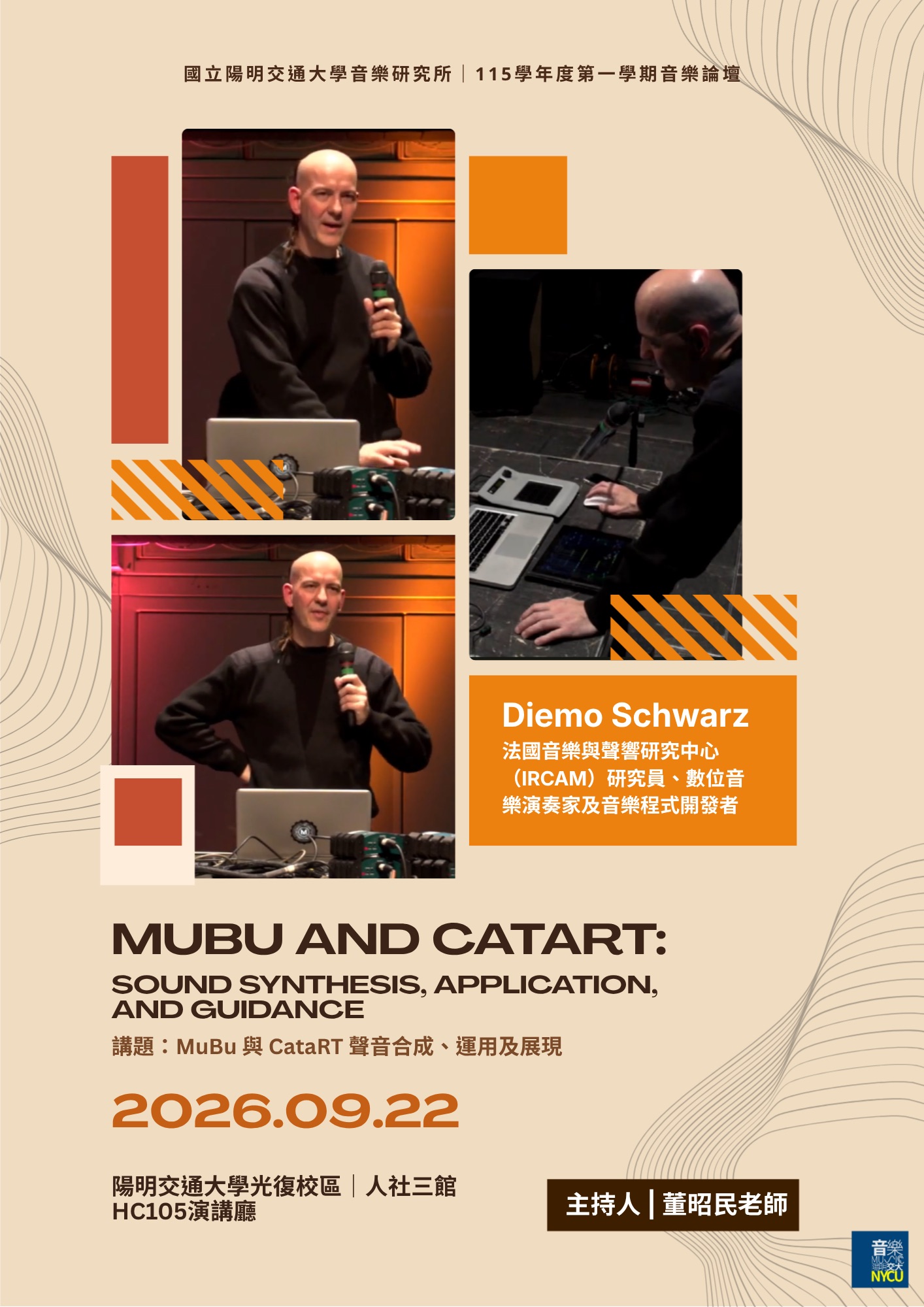
Diemo Schwarz, born in Germany in 1969, is a researcher at IRCAM, and a musician and creative programmer.
He performs on his own digital musical instrument based on his CataRT open source software, exploring different collections of sound with the help of gestural controllers that reconquer musical expressiveness and physicality for the digital instrument, bringing back the immediacy of embodied musical interaction to the rich sound worlds of digital sound processing and synthesis.
He interprets and performs improvised electronic music as member of the 30-piece ONCEIM improvisers orchestra, or with musicians such as Frédéric Blondy, Benjamin Duboc, Richard Scott, Gael Mevel, Pascal Marzan, Massimo Carrozzo, Nicolas Souchal, Fred Marty, Hans Leeuw.
He composes for dance and performance (Sylvie Fleury, Frank Leibovici, Françoise Tartinville), video (Benoit Gehanne and Marion Delage de Luget), and installation (Christian Delecluse, Cecile Babiole),
His scientific research on sound analysis/synthesis and gestural control of interaction with music is the basis of his artistic work, and allows to bring advanced and fun musical interaction to expert musicians and the general public via installations like the dirty tangible interfaces (DIRTI) and augmented reality (Topophonie mobile).
In 2017 he was DAAD Edgar-Varèse guest professor for computer music at TU Berlin, and in 2022 artist in residence in the Arts, Sciences, Societies fellowship program of IMéRA institute of advanced studies, Aix–Marseille Université.
Diemo Schwarz, a researcher at IRCAM (Institute for Research and Coordination in Acoustic/Music), will present MuBu and CataRT—powerful audio tools he developed. Frequently used within the Max/MSP software environment, these tools enable musicians and sound designers to perform corpus-based concatenative synthesis; simply put, this technique is akin to assembling a "jigsaw puzzle" from countless tiny audio fragments to create entirely new and unique sounds.
CataRT and MuBu redefine the logic of traditional sound synthesis by operating through the following steps:
1.Corpus Analysis (Descriptor Analysis): Large amounts of audio (such as bird calls, instrumental sounds, or even an entire song) are input, and the system automatically analyzes and tags their characteristics.
2.Audio Mapping: Characteristics are mapped onto X and Y axes. For instance, the X-axis might represent "pitch" (high or low), while the Y-axis represents "timbre" (bright or dark).
3.Target Concatenation (Audio Mosaicing): When you specify a target location or input a live audio signal, CataRT rapidly searches the library for the fragments that "most closely resemble" the target and reassembles them for playback. This allows, for example, a guitar sound to be reconstructed from countless fragments of kitchen-based impact sounds.